Showing posts with label Bioregion. Show all posts

POO POWER: Chicken Manure to Power UK Homes


by Timon Singh

Chicken manure is becoming a renewable energy source of choice for many countries. The UK has a plan to convert a local Alfagy biogas station so that it uses agricultural waste, such as feedstock waste and manure, to create electricity.

The power plant, which is located on the southern outskirts of Cirencester, is scheduled to be opened on November 1. Its location in Cirencester was selected due to the area’s large chicken population and its proximity to other agricultural industries.

Various UK projects have looked at plans to use animal waste to create energy, including one that would have utilised cow manure as an energy source. this Alfagy plant will use the manure of smaller farm animals, as well as agricultural feedstock. Local farmers will deliver any agricultural plant waste, chicken litter, and pig manure that they have to the station, for which they will be paid for. They will also receive free heat for their animal barns, grain-drying bins, and homes. It is a fantastic opportunity for farmers, and it is hoped that many will join the endeavour.

Once delivered to the power plant, the agricultural waste will be converted into biogas via an anaerobic digester. According to Alfagy, the station will then use a combined heat and power (CHP) system in which one 260-kilowatt CHP unit can perform at a 42.9 percent electrical efficiency. When the plant is operating at full capacity, it is expected to produce about 1 megawatt of electricity per year — enough to power about 350 Cotswolds homes (Cirencester’s population is about 19,000). The station will also create digestate fertilizer.

In a statement, Alfagy said, “This ‘digestate’ is a powerful fertilizer that decreases the average fertilizer costs by up to 100 percent, which is a major cost to farmers and the environment. Normal fertilizer production uses large amounts of fossil fuel [and emits] significant quantities of carbon dioxide, and the finished product is transported over great distances to farmers. Whereas [if] the fertilizer is produced locally at the power plant, there is no necessity in importing it from the U.S.”
Read more

Waste-to-fuel reactor wins 2010 industry award


A new type of reactor that converts waste materials into liquid fuels has won the 2010 award from CWC World XTL, a conference for the gas, coal and biomass to liquids industry.

The microchannel reactor developed by Velocys, an Ohio-based subsidiary of the UK’s Oxford Catalysts, is designed to provide a small-scale but high-intensity way to produce liquid fuels from waste that’s close to the waste source. In that way, waste can be converted to productive use without having to transport it long distances, which could erase the environmental benefits of the process.

The Velocys reactor can achieve productivity levels that are orders of magnitude higher than those of conventional Fischer-Tropsch reactors. (The Fischer-Tropsch process uses chemical reactions to convert hydrogen and carbon monoxide into liquid hydrocarbons.) The reactor can also operate economically at outputs as low as 500 barrels of liquid fuel per day.

A demonstration plant that will use the Velocys reactor to convert gasified woodchips into fuel is currently being commissioned in Güssing, Austria.

“Our innovation represents a whole new way of looking at the problems associated with the distributed production of new-generation biofuels, and the fuels produced offer significant environmental benefits over equivalent products from fossil fuels,” said Roy Lipski, CEO of the Oxford Catalysts Group.
Read more

Las Gaviotas: A Sustainable Community Cut Off From the World Almost 40 Years Ago


It sounds like something out of a fairy tale or a children's book, a community deep in the wild jungle of Colombia, cut off from society almost 40 years ago. Then, after the rest of the world turned their back on them, they suddenly take great interest as it turns out this community has found something the rest of the world needs. Energy. And not just a new supply source but something even better. They've figured out how to be sustainable without outside influence or resources, reports The New York Times.

In the 1960's a Colombia developer named Paolo Lugari, while on a road trip through the country, stopped at an abandoned parcel of land and imagined an entire village before his eyes. The land was so poor and the area so remote - "visitors" have to pass Guerrilla check points or fly in to make it there - that no one wanted to live there. Mr. Lugari was in his very early 20's at the time. He wanted to find one of the hardest places to live and see if he could make it work. This was before the oil crisis of the 70's, but even then he knew fuel and other resources would be scarce.

Today there are 200 residents and they, "have no guns, no police force, no cars, no mayor, no church, no priest, no cellphones, no television, no Internet. No one who lives in Gaviotas has a job title." So what do they have? How did this community of 200 people create a society that is now the envy of urban planners, including Amory Lovins, around the world?

When you live in the middle of nowhere, you have to get creative. Initially scientists helped design the buildings, homes, laboratories and factories in the area but don't come around much these days thanks to all of the violence. Today they have a solar kettle for sterilizing water and solar kitchen, and a 19,800-acre reforestation project with species chosen to produce resins for biofuels, as well as, for creating conditions upon which other native plants can flourish. A children's seesaw powers the local water pump. Community members feel they are there to "try to lead a quiet life, depending on nothing but our own labor and ingenuity." Sounds pretty idyllic today.

The reforestation project is one of the most successful in the world, considering that everywhere around it is still a "tropical desert." To say Las Gaviotas is doing okay for itself is an understatement. People from outside the village trek to Las Gaviotas to earn $500 a month, which is double what they would earn in other rural areas. A mycorrhiz fungus was added almost 20 years ago to help break up and digest the poor soils and in its place other species grew up. They use the resin from the trees to power their motorbikes and tractors and sell the excess. When China dumped cheap resin imports in Colombia, the community was forced to drop their prices by almost 40% to compete.

It might sound like a fairy tale, but Las Gaviotas also has hardships too. Their remote location makes them a likely target for guerillas and organized crime trying to sneak shipments out to other areas, or at least likely that someone trying to hide something will stumble upon them. There are several guerilla and paramilitary groups that are located not too far from Las Gaviotas, but as one resident said, "we don't take part in this war, and we ask those who enter our village to do so without their rifles. So far, for us at least, this has worked." Journalists and visitors who have come this year must only stay the day and leave before dark under fear of kidnapping.

Also, the community itself is very small, and with only 12 children in school, many question how long this "experiment" can go on. As many of the residents have said, "we have survived. Maybe, at this time and place in Colombia, that is enough."
Read more

FSC vs SFI - WTF???

For those few people who seem to "get it" where sustainable forestry is concerned, here is a point to watch.

FSC (Forest Stewardship Council)- Established in 1993 as a response to concerns over global deforestation, FSC is widely regarded as one of the most important initiatives of the last decade to promote responsible forest management worldwide.
FSC is a certification system that provides internationally recognized standard-setting, trademark assurance and accreditation services to companies, organizations, and communities interested in responsible forestry.
Only FSC:
  • prohibits conversion of natural forests or other habitat around the world
  • prohibits the use of highly hazardous pesticides around the world
  • prohibits the cultivation of genetically modified trees (GMOs)
  • respects the right of indigenous peoples around the world
  • controls each certified operation at least once a year – and if they are found not to comply, the certificate is withdrawn
Some FSC forests:


SFI (Sustainable Forestry Initiative) - Following the old adage, “if you can’t beat them, join them,” the American Forest & Paper Association created its own certification system for labeling sustainably managed forests, requiring all members to ‘self-certify’ that they comply with their “Sustainable Forestry Initiative” (SFI) requirements. (SFI became an independent non-profit in 2007.) Buoyed by the support of behemoth members such as Weyerhaeuser the SFI has grown rapidly, with SFI operations now covering approximately 90% of the industrial forestland in the US.

Michael Brune, executive director of the Rainforest Action Network described the SFI efforts as “a new green coat of paint over the same tired practices”.

Some SFI Forests:


HERE IS THE MOST TELLING ONE:

Notice the SFI vs the FSC forest. Which one would you prefer?
The real cost of ignorance is not in dollars!

Read more

Ronnie Trash

Read more

What does Copenhagen mean for you?

The "climate summit" was a real fizzle. I think we all knew that the realistic chances of meaningful change being made was almost nil as the United States (25% producer of carbon emissions) never spent any real time making the climate talks a priority. Obama's last minute trip was way to little and way, way to late.

But, realistically, what did we expect?

So what do you and I do now? Well the same thing I have been pushing since I started this blog. It comes down to a simple concept:

"THINK GLOBALLY, ACT LOCALLY".

So, let's commit ourselves to pursuing transition on a local level. Start a transition steering committee. Begin making the type of changes in your personal life that can be an example to neighbors.

Refuse to spend money in the Wal Marts and Targets of the world. Direct your spending toward local businesses, that sell local or fair trade products. Do not be seduced by cheap anything.

Shop in local food stores, farmers markets and as much as possible directly from the farmer.

Almost every developed nation is now seeing a locavore movement, plug in!

Folks, we know that the kind of change that is needed will not happen if we wait for government. The kind of change that will make a difference is beyond hope of being achieved, so at this point the call is to adapt and get out ahead of the curve.

Our Katuah bioregion is a great area to weather the coming storms (literally!).

Remember, make the start and begin the discussions because we do not know how long before the situation becomes critical!
Read more

Action Now or Reaction Later

We all face the same global issues of climate change, economic uncertainty and resource scarcity, however the specific circumstances and reactions to these are each different. The concept of "thinking globally but acting locally" is what this is all about. If you live in northern Georgia the most pressing issue for you to consider may be drought and water scarcity, if you live in Cuba you may be faced with energy shortages most immediately, if you live in the Ukraine environmental degradation may be your most pressing issue. Regardless of the area, if you are conscious of the circumstances this species finds itself in, there is plenty to think about.

Unfortunately, Americans as a whole are either totally unaware or worse in denial about the impending changes. Be that as it may, as I have said before, this is the most exciting time to be alive, a time of extreme change and revolution.

I encourage you to think about the issues facing your local community and to decide to make a step towards sustainability. Join or start a group to discuss the issues. Make a start at changing your thought process to one of long term harmony. Start making the changes in your mind that will allow you to flourish in the coming time of change.

Peak energy is here, unsustainable population is here, species collapse is here, the future holds tremendous turmoil to those who try to cling to the old paradigm. I guarantee in the US that we as a country will be the last to embrace the coming changes as a society. It is clear to me that the US political "leadership" is leading us off a cliff. They do not have the vision or will to make the type of changes the next 40 years will require. Therefore, it is up to us, you and me to make those changes.

Act now or react later, it is your choice.
Read more

Virginia Getting Ready to Split Over Climate Change


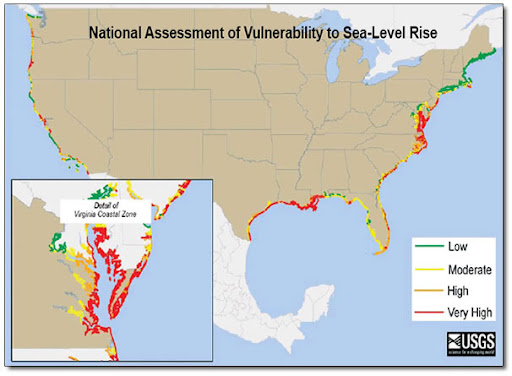
As a state, Virginia seems ready to elect a governor who does not believe in evolution or climate change. If elected McDonnell will undoubtedly slow the meager progress towards meaningful regulatory change needed to combat climate change.

But wait, there is something that will happen to change this. As time goes on, maybe fall 2010 or 2011 or 2012, there will be a hurricane that floods large areas of a coastal city. Maybe in Virginia, maybe not, but it will awaken a sleeping conflict that will tear Virginia apart.

The policy makers in the coastal regions of Virginia are well aware of the predictions of the impact of even a small amount of sea level rise on their areas. While many hide their heads in the sand and fail to confront the issue head on mostly because of strong right wing nut opposition, the earth continues to warm and the sea continues to rise. So what will happen, I predict that sooner rather than later, there will be a natural disaster in the US that will finally push the state's eastern lawmakers to force the rest of the state to confront the challenges of climate change. My guess is that it will come under the reign of McDonnell & Griffith. If so, we will have a grand battle on our hands as the eastern right wing take on the western right wing.

Be prepared and stay tuned. It should be interesting.
Read more

New DIY Renewable Energy Club Forming

REEVA = (Renewable Energy & Electric Vehicle Assn) and will be revived in November in the Roanoke Valley!!

Initial meeting is November 8th Sunday at 1pm at Shoneys at Exit 137 off Route 81

The idea is to make renewable energy affordable for interested people by doing the labor yourself and learning the process.

Typically we'd meet at a project house on solar, wind or EV's for a build & learn session to help people with renewable energy projects and reduce their cost.
Read more